Ethiopia’s rise as a regional power, its nationalist assertion through projects like GERD, and India’s recalibrated Africa strategy have created a moment of convergence.

In the aftermath of the landmark Bandung Asian–African Conference of 1955, Ethiopian Emperor Haile Selassie undertook a three-week visit to India in late 1956, signalling the early warmth and strategic intent of India–Ethiopia relations. During the visit, the Emperor travelled extensively across the country, including Mumbai, Calcutta, Bangalore, Delhi as well as Poona and Dehradun, engaging with India’s political leadership and observing its post-independence development model firsthand. The journey reflected a shared post-colonial aspiration between the two ancient civilisations and laid the foundation for a relationship that has since evolved into one of India’s most enduring partnerships in Africa.
With Prime Minister Narendra Modi scheduled to visit Ethiopia on December 16, this rich diplomatic legacy is set to be further strengthened, as both sides increasingly see strategic value in deeper, more structured engagement. The visit comes at a time when Ethiopia’s regional standing and India’s Africa policy are aligning more closely than ever before.
Ethiopia has emerged as one of the continent’s fastest-rising and most influential states, combining demographic scale, diplomatic centrality, and growing strategic ambition. As Africa’s second-most populous country, it enjoys immense economic and security weight in the Horn of Africa, shaping regional trade and stability. Beyond economics, Ethiopia’s influence is magnified by Addis Ababa’s role as host of the African Union headquarters and several UN agencies, making it the continent’s primary diplomatic hub and a focal point for agenda-setting.
Recently, the inauguration of Grand Ethiopian Renaissance Dam (GERD), became a powerful symbol of Ethiopian nationalism. Successive governments have framed GERD as Ethiopia’s right to equitable resource use and resistance to external pressure, particularly in Nile negotiations. In doing so, the dam has projected Ethiopia as a more assertive regional actor. Large-scale projects underway in the country, particularly in power generation and transport corridors, position Ethiopia as a future energy and logistics anchor for East Africa.
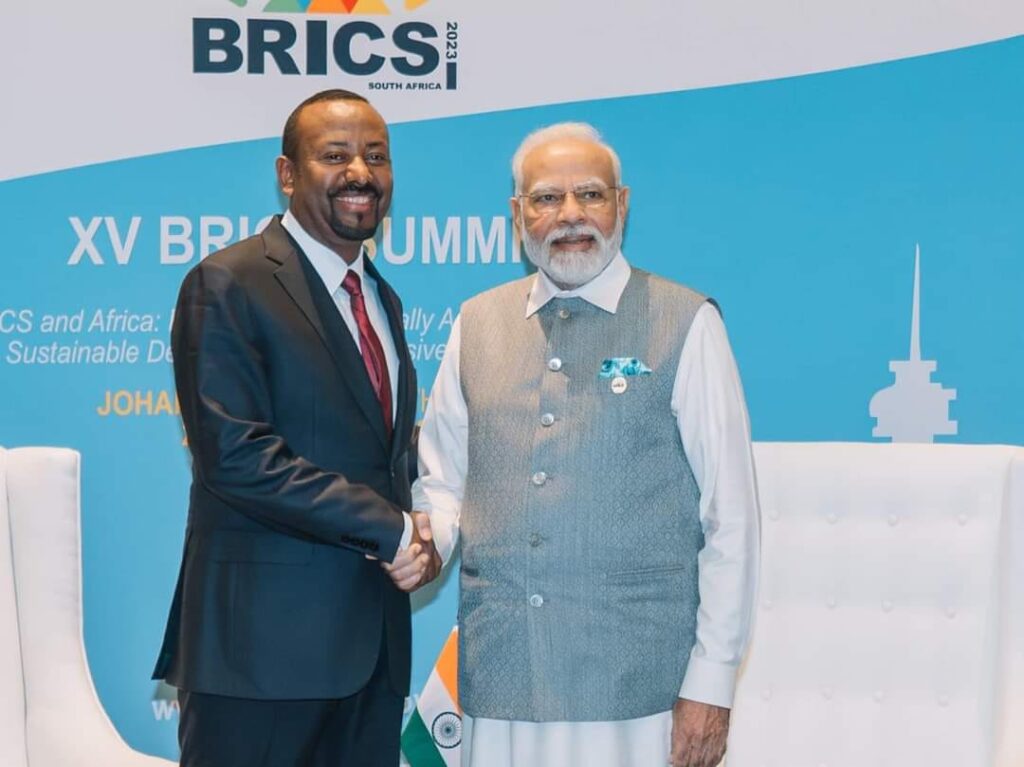
It is against this backdrop that PM Modi’s visit must be understood. Ethiopia’s rapid transformation and strategic weight required the highest-level political engagement from Indian side, to leverage the partnership. Addis Ababa’s economic reform agenda has given rich dividends for its people and industry and has created fresh opportunities for Indian investment and expertise. During the recently concluded G20 Summit 2025 in Johannesburg, when PM Modi briefly interacted with the Ethiopian Prime Minister Abiy Ahmed Ali, he indicated towards the high priority areas of cooperation between the two countries. “India and Ethiopia share a partnership rooted in history and strengthened by developmental cooperation. We will keep boosting ties in sectors like technology, skilling and more,” he had said.
Ethiopia counts India among its top trading partners, accounting for over 10 per cent of its global trade. Even more significant is Indian investment – about 650 Indian companies operate in Ethiopia, with approved investments exceeding USD 5 billion and an estimated USD 3 billion already on the ground across agriculture, manufacturing, textiles, pharmaceuticals, water management, and healthcare. India’s diaspora in Ethiopia predates modern diplomatic ties. Indian traders, professionals, and entrepreneurs are deeply embedded in Ethiopian commercial life and are widely regarded as reliable, and long-term stakeholders. This community acts as a quiet but effective bridge between the two societies. Equally significant is India’s educational footprint. Since the 1950s, Indian teachers and professors have staffed Ethiopian schools and universities, particularly in science, mathematics, engineering, and commerce. It is a common sentiment in Ethiopia that nearly everyone from certain generations has been taught by an Indian teacher. This legacy has created enduring institutional familiarity and goodwill that no short-term investment can replicate.
The year 2025 has also seen remarkable momentum in the bilateral engagement in diverse sectors. In the beginning of the year, on the sidelines of the G20 Foreign Ministers’ meeting in Johannesburg, EAM S. Jaishankar had met with Ethiopian Foreign Minister (Feb 2025) and also previously during the 79thUNGA (September 25, 2024). A high-level ISA delegation led by Director General of the International Solar Alliance (ISA) visited Ethiopia to discuss the country’s solar energy development plans. (11-15 Aug 2025). From the Ethiopian side, Gen. Teshome Gemechu, Director General for Defence Foreign Relations and Military Cooperation of Ethiopia visited New Delhi from 15-17 October 2025 for the first ever Joint Defence Cooperation meeting. The visit marks a milestone in long standing bilateral defence relationship between the two countries. In November, a delegation headed by State Minister of Health Firehiwot Abebe Gobena visited India to enhance collaboration with the pharmaceutical and healthcare sectors.
Political solidarity was further reinforced following the Pahalgam terrorist attack and Operation Sindoor, when a multi-party Indian parliamentary delegation led by Supriya Sule visited Ethiopia from May 30 to June 1, 2025. The delegation held wide-ranging discussions with senior Ethiopian leaders, including former Prime Minister Hailemariam Dessalegn, Speaker of the House of People’s Representatives Tagesse Chafo, and representatives of the African Union. Ethiopia expressed strong solidarity with India and reiterated its firm commitment to combating terrorism, a position articulated clearly by Ethiopian Ambassador to India Fesseha Shawel Gebre.
With Prime Minister Modi’s visit, India–Ethiopia relations are entering into a new phase of growth and cooperation with increasing focus on leveraging India’s experience of using its digital Public infrastructure (DPI) model, including the Unified Payment System (UPI), Cybersecurity, defence cooperation, as well skilling and capacity development. Ethiopia’s rise as a regional power, its nationalist assertion through projects like GERD, and India’s recalibrated Africa strategy, with strong emphasis on ‘south-south cooperation’ have created a moment of convergence. How both sides capitalise on it will shape the future trajectory of one of India’s most consequential partnerships in Africa.