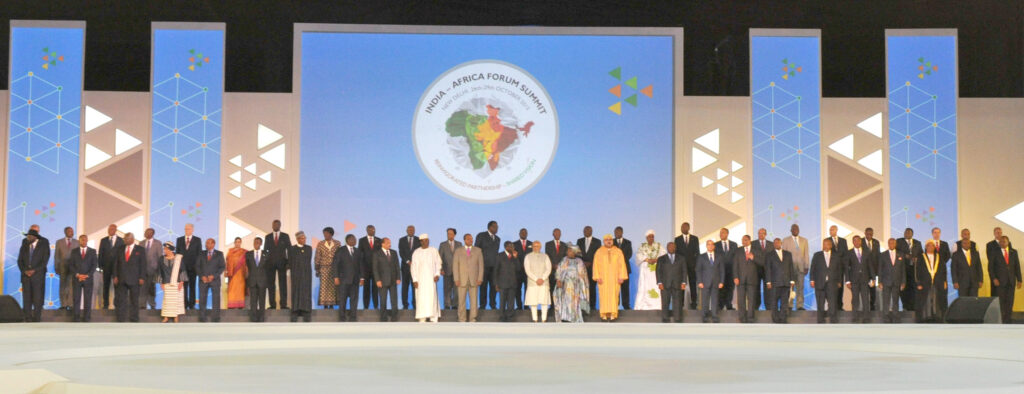
New Delhi / NARENDER YADAV
The India–Africa Forum Summit (IAFS) continues to serve as the central institutional mechanism underpinning relations between India and the African continent. Envisaged as a triennial platform, its continuity has been disrupted over the past decade due to successive global crises, most notably the COVID-19 pandemic. This extended hiatus has created a strategic gap at a time when Africa’s geopolitical and economic relevance is steadily rising. In this context, the planned convening of IAFS-IV in May 2026 offers a critical opportunity for India to recalibrate, consolidate, and revitalise its engagement with Africa.
Know more about the journey of IAFS here:
The first IAFS, held in New Delhi in April 2008, marked a watershed in India–Africa relations. It brought together Indian leadership with representatives from 14 African countries selected by the African Union (AU). The summit institutionalised the partnership through two foundational documents: the Delhi Declaration (2008), which articulated shared political commitments, and the Framework for India–Africa Cooperation, outlining collaboration across key sectors such as economic development, science and technology, infrastructure, energy, and social sectors. Importantly, it established the normative basis of the partnership—grounded in South–South cooperation, mutual respect, and shared developmental priorities.
The second summit, convened in Addis Ababa in 2011 at the headquarters of the African Union, expanded both participation and scope. With representation from 15 African countries, it reinforced earlier commitments while introducing a stronger implementation focus. Key outcomes included the Addis Ababa Declaration and the Joint Action Plan, which operationalised cooperation in areas such as trade, capacity building, ICT, and security. Initiatives like the Pan-African e-Network Project exemplified India’s emphasis on technology-driven development partnerships.
The third IAFS, held in New Delhi in October 2015, marked a significant scale-up in India’s diplomatic outreach. With participation from a large number of African nations, it signalled a shift towards a more inclusive and consultative framework. The summit moved beyond broad principles to emphasise action-oriented cooperation, with India committing substantial concessional lines of credit and grant assistance for African development. The Delhi Declaration (2015) aligned the partnership with continental and global agendas, including the African Union’s Agenda 2063 and the UN Sustainable Development Goals (SDGs). The India–Africa Strategic Cooperation Framework further refined priority areas such as renewable energy, health, education, and peace and security.
IAFS-IV in May 2026 marks a pivotal moment to renew India–Africa relations. By reinstating institutional continuity, focusing on effective implementation, and aligning with Africa’s development priorities, India can strengthen its position as a reliable partner and a key contributor to a more inclusive global order.