India’s green transition is no longer just about replacing fuelwood with clean cooking fuels – it is about unlocking the economic, environmental, and strategic value of forest biomass to build a resilient bioeconomy for the Global South.

Amid supply constraints and geopolitical tensions (such as conflicts in West Asia), rising and volatile global prices, Hon’ble Prime Minister Narendra Modi identified the 3Fs as fuel, fertiliser, and foreign exchange, as the sectors that pose major external challenges to Indian economy. These sectors form the foundational pillar of government fiscal planning and welfare targeting.
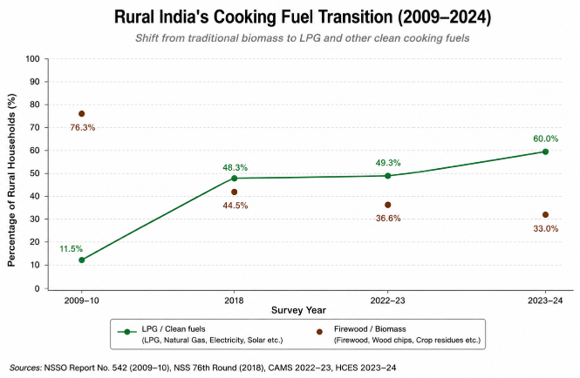
For more than a century, India’s household energy story has been quietly unfolding in village kitchens. Following one of the world’s largest clean cooking initiatives, LPG has become the dominant household cooking fuel. The Household Consumption Expenditure Survey (HCES) 2023–24 indicates that approximately 60 per cent of Indian households now primarily cook using LPG, while nearly 33 per cent continue depending on firewood. These figures represent one of the most significant household energy transitions in independent India. Fig. 1 shows that in rural India the decisive turn towards clean fuel reducing dependence on forest biomass material coincides with the launch of the Pradhan Mantri Ujjwala Yojana (PMUY) in May 2016. Designed to provide free LPG connections to poor households dependent on traditional cooking fuels, the programme sought to improve women’s health, reduce indoor air pollution and ease the burden of fuelwood collection. More than 90 million households received LPG connections, and national LPG coverage expanded from 62 per cent in 2016 to almost universal coverage by 2021.
Before Liquefied Petroleum Gas (LPG), millions of Indian families depended on cow dung cakes, crop residues and fuelwood collected from nearby forests. This remarkable transition is not merely a story of technological change—it is the outcome of nearly a century of evolving agricultural policy, forest management, environmental concerns, public health interventions and larger public good.
The origin of this journey can be traced back to the colonial administration’s concern over declining soil fertility and increasing food requirements. During the early decades of the twentieth century, cow dung cakes constituted one of the principal cooking fuels in rural India. While they provided an inexpensive source of household energy, agricultural scientists argued that burning dung deprived Indian agriculture of valuable organic manure. Every dung cake burnt in the kitchen represented nutrients that never returned to the soil. The decline in household fuelwood demand also presents an opportunity.
Evolution of Forest Policy
The Forest Policy of 1894 had already recognized that forests producing fuelwood, grazing resources and small timber were essential for meeting local requirements. This thinking was institutionalized through the National Forest Policy of 1952, which acknowledged that diversion of forests without adequate planning deprived villages of fuelwood and small timber was contributing to ecological degradation. The policy recommended the establishment of Village Forests, popularly described as Fuel Forests, specifically to provide firewood, fodder, fencing material and small timber to surrounding communities. It further emphasized that harvesting should remain within the annual regenerative capacity of forests and encouraged local Panchayat participation in forest management.
The National Forest Policy of 1988 expanded this approach by linking forest conservation with people’s participation. Recognizing that fuelwood remained the principal household energy source in rural India, the policy called for large-scale afforestation programmes to augment fuelwood supplies while reducing pressure on natural forests.
The evolution of National Forest Policies reveals an important historical reality: for much of the twentieth century, India’s forests were not viewed merely as ecological assets but also as the country’s largest decentralized source of household energy.
India’s transition towards clean cooking has never followed a simple replacement model because unlike commercial fuels, fuelwood could often be collected from nearby forests and common lands without direct monetary expenditure minimizing household cash expenditure despite considerable time and labour—primarily from women and children. For low-income families with irregular earnings, this economic logic outweighed the hidden costs of indoor air pollution or environmental degradation.
Even households possessing LPG connections frequently continue to use firewood for preparing traditional meals requiring prolonged cooking or during periods when purchasing LPG refills becomes financially difficult. Energy economists describe this phenomenon as fuel stacking, where households simultaneously use multiple energy sources depending upon affordability, availability and cooking requirements.
Though the 1988 forest policy speaks about improved chulhas, reducing dependence on forest biomass material and prompting use of cleaner energy sources and efficient use of bio resources but a decisive turning point came with the launch of the Pradhan Mantri Ujjwala Yojana (PMUY) in May 2016 after a lapse of 28 years.
The decline in household fuelwood demand also presents an opportunity. Instead of allowing excess forest biomass to accumulate and potentially increase wildfire risk, India could adopt scientific biomass management strategies. Dry branches, fallen wood and forest litter collected through sustainable forest management programmes can be converted into biochar using controlled pyrolysis. India’s clean cooking transition should therefore be evaluated not only through the lens of public health and energy access but also through its long-term ecological consequences. To date, these questions have received limited scientific attention and deserve systematic investigation.
From fuelwood to biochar: the next transition
Pyrolysis breaks down the biomass while locking its carbon into a stable solid form rather than releasing it as CO2 through open burning or decomposition. The resulting biochar can be used to improve soil health, retain moisture, and sequester carbon for centuries. The technology can be modified to produce biochar, bio-oil and wood vinegar: increasing the economic sustenance of such projects.
To showcase the viability of this approach a 1.5 TPD Biochar Research & Training Facility has been inaugurated in Himachal Pradesh supported by the Forest Department, ProClime, Dr Y.S. Parmar University, and IIT Roorkee, converts pine-needle waste into biochar, cutting forest-fire risk, locking away carbon, and creating local livelihoods, producing approximately 0.45 tonnes of biochar per day, the plant will serve as both a working production unit, training facility for future plants. The facility has been commissioned to address the state’s chronic pine needle and forest biomass surplus, which has long posed a forest-fire hazard, by converting this waste into a stable, high-value soil amendment.
Such an approach offers multiple benefits. Biochar can serve as a low-emission renewable fuel, providing an alternative clean energy source in regions where complete LPG dependence remains economically difficult. More importantly, biochar can be incorporated into soils or blended with conventional fertilizers to produce bio-based soil amendments that improve soil organic carbon, water retention and nutrient-use efficiency.
For a country that continues to spend substantial resources on fertilizer imports, integrating biochar into fertilizer formulations could strengthen India’s circular bioeconomy while simultaneously improving soil health and reducing carbon emissions. It would also create rural enterprises centred on biomass processing, generating employment while reducing combustible material inside forests.
India’s fuelwood transition reflects more than changing household energy preferences. It mirrors a century of evolving public policy—from the colonial recognition that cattle dung belonged in agricultural fields rather than cooking stoves, to independent India’s forest policies promoting village fuelwood plantations, and finally to modern clean cooking programmes that have transformed millions of lives.
The next stage of this transition should move beyond the simple objective of replacing one cooking fuel with another. Policymakers should invest in understanding how declining fuelwood extraction is reshaping forest ecosystems, biodiversity and wildfire dynamics. Simultaneously, India should develop a national strategy for the scientific utilization of surplus forest biomass through biochar and biofertilizer production thereby making us to save precious foreign exchange spent on account of fertilzers purchases.
The story of India’s fuelwood transition, therefore, is far from complete. It began with concerns over agricultural productivity, evolved into a programme for rural energy security and has now become a public health success. Its future may lie in something even more ambitious: building a circular bioeconomy where cleaner kitchens, healthier forests and more productive soils reinforce one another.
A scalable solution for Global South
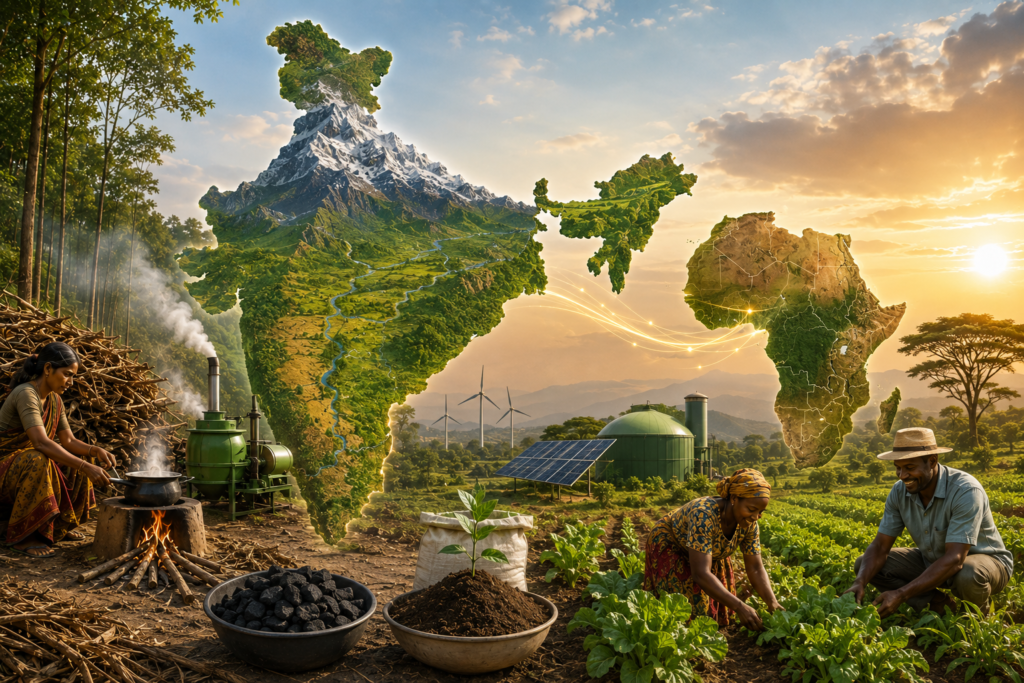
For Global South, particularly across Africa, India’s experience of scientific utilization of surplus forest biomass presents a transformative opportunity to address multiple development challenges through a single, integrated solution. Converting this surplus biomass into biochar and biofertilizers not only transforms a largely underutilized resource into a valuable asset for sustainable development, it has the potential to create new livelihood opportunities through community-based biomass collection, decentralized processing enterprises, and participation in emerging carbon markets.
By promoting biochar and biofertilizer value chains, India and Africa can jointly demonstrate how nature-based, circular bioeconomy solutions can accelerate climate action while generating inclusive economic growth, restoring degraded landscapes, strengthening rural communities, and advancing the shared sustainable development aspirations of the Global South.
(Sushil Kumar Singla is an Indian Forest Service Officer. Aditya Singla is Assistant Director, African Centre of India)