India is increasingly sharing its expertise in digital governance with countries across Africa. Its emerging engagement with Burundi comes at an important juncture, as the East African nation seeks to harness digital technology as a catalyst for development and advance its ambition of becoming an emerging country by 2040 and a developed nation by 2060
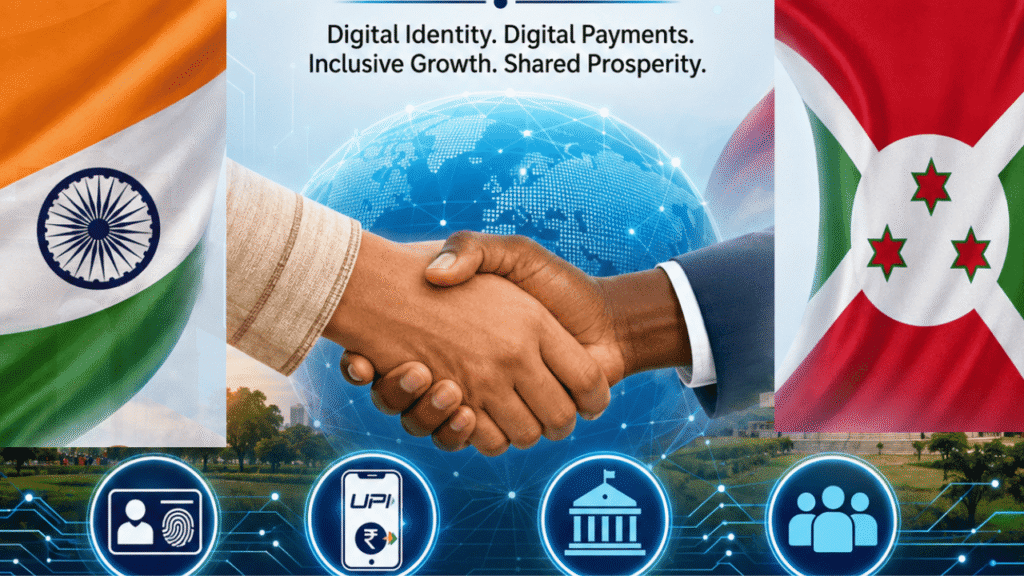
On July 1, External Affairs Minister S. Jaishankar extended Independence Day greetings to Burundi on the occasion of its 64th anniversary, conveying his wishes to Burundi’s Minister of Foreign Affairs and Development Cooperation Ambassador H.E. Édouard Bizimana, and the people of Burundi. A few days earlier, on June 22, 2026, India’s Ambassador to Burundi, Upender Singh Rawat, met Isidora Ntakiyiruta, Adviser to Burundi’s Ministry of Finance, Budget and Economic Planning. Their discussions focused on cooperation in digital government services and economic development.
India and Burundi have maintained cordial relations, with a resident mission established in New Delhi in 2009. For decades, India–Burundi relations have been built around a familiar development partnership model – capacity building, infrastructure, healthcare, education and development assistance. The two countries have held two Foreign Office Consultations, discussing bilateral cooperation in trade, agriculture, and renewable energy.
But a new chapter may now be opening. The emerging conversation around digital identity and electronic payments has the potential to transform the relationship from one centred on physical infrastructure and technical assistance to one increasingly focused on digital public infrastructure (DPI), financial inclusion and citizen-centric governance – areas that are increasingly becoming central to the development strategies of countries across the Global South.
During the meeting Ambassador Rawat, briefed about India’s interest in sharing its experience in digital transformation, particularly in digital identity systems and electronic payment solutions. Burundi, in turn, welcomed the proposals as being aligned with its efforts to modernise public services and accelerate digitalisation within government institutions.
Burundi’s tech-driven development Agenda
Last two-years have been quite significant for Burundi, with the launch of a $92 million project to improve internet access and digital public services. The project dubbed PAFEN (Projet d’appui aux fondations de l’économie numérique- Support Project for the Foundations of the Digital Economy) is funded by the World Bank to help Burundi achieve its goal of becoming an emerging country by 2040 and a developed nation by 2060.
Burundi is also participating in the Data Governance in Africa initiative, spearheaded by the United Nations Economic Commission for Africa (ECA), in partnership with GIZ-AU through the EU Delegation Fund and in collaboration with the African Union Commission (AUC) and AUDA-NEPAD. Alongside Tanzania, Mozambique and the Democratic Republic of the Congo (DRC), Burundi is among the countries benefiting from the current phase of the initiative.
Importantly, Burundi has demonstrated strong leadership in developing its National Data Governance Strategy. The strategy is aligned with both the African Union Data Policy Framework and Burundi’s Vision 2040–2060. Its validation on November 7, 2025, represented an important milestone in the country’s efforts to strengthen digital sovereignty and establish a coherent framework for data governance, following a consultative process that began earlier that year.
These developments suggest that Burundi is not approaching digitalisation merely as a technological upgrade. Rather, it is increasingly viewing digital infrastructure, data governance and connectivity as strategic components of national development.
Multi-sectoral development riding on technology
The significance of digital public infrastructure lies precisely in its ability to connect seemingly different areas of development. A reliable digital identity can facilitate access to government services, banking, healthcare, education and social protection. An interoperable digital payment system can reduce dependence on cash, lower transaction costs, improve transparency and bring more people into the formal financial system.
For Burundi, therefore, digital identity and electronic payments are not simply technology projects. They can become foundational infrastructure for a more inclusive economy.
Indian Expertise for roll-out in Africa

India’s experience is particularly relevant because its digital transformation was not built around a single application or technology company. Instead, India developed interoperable public digital rails that allow multiple public and private services to build upon common infrastructure.
The Modular Open Source Identity Platform (MOSIP), for example, was designed to help countries establish sovereign and adaptable digital identity systems without becoming excessively dependent on proprietary technology vendors. India has increasingly positioned such digital public infrastructure as an element of its development partnership with the Global South.
Similarly, India’s Unified Payments Interface (UPI) demonstrated how an interoperable payment architecture can radically change the economics of everyday transactions. What began in India as a domestic innovation has increasingly become part of India’s international technology diplomacy.
The combination of digital identity, payments and data-enabled public services has become an important element of India’s governance and economic architecture. The proposed cooperation with Burundi could allow the country to adapt some of these principles to its own circumstances rather than simply replicate India’s model.
The Road Ahead
Burundi’s interest in digital identity and electronic payments places the bilateral relationship within a much larger global trend: India is increasingly sharing not only products and expertise with developing countries, but also digital governance architectures. The India–Burundi digital partnership is still at an exploratory stage. Its eventual success will depend on whether the two countries can translate the current dialogue into scalable, sustainable and locally relevant initiatives. To take it forward would require investment in connectivity, cybersecurity, data protection, digital literacy and institutional capacity alongside the technology itself.