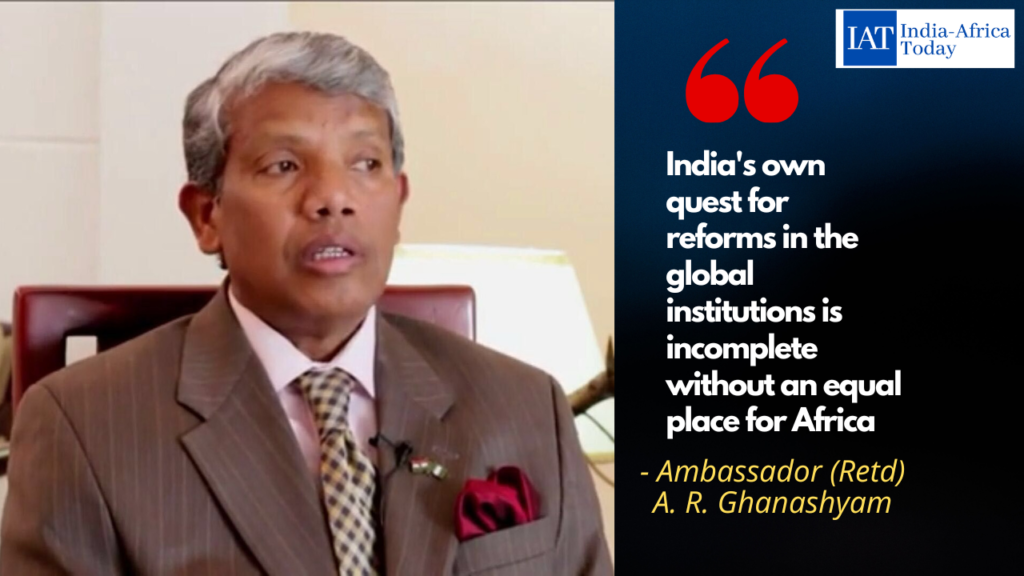
Although the much-anticipated 4th India–Africa Forum Summit (IAFS) could not be convened due to the Ebola outbreak, it is no longer a setback to the growing momentum of India–Africa relations, asserts Amb. (Retd) A.R GHANASHYAM in an exclusive conversation with Rao Narender Yadav,Director, African Centre of India.
Q. How do you see the strategic significance of cooperation and collaboration between India and Africa in the evolving global order?
When I presented my credentials to then Nigerian President Goodluck Ebele Jonath in March 2014 as India’s High Commissioner to Nigeria, he told me “My dear Ambassador, an entire generation of Nigerians were taught by Indian teachers, treated by Indian doctors and they grew up wearing Indian apparel and watching Indian movies. Wherever you go in Nigeria you will find that your country has enormous goodwill.” This could be said by many other African Heads of State to an Indian Envoy. Thanks to the many linkages of the past, India and Africa have developed deep bonds of friendship. It is particularly profound in the case of English speaking former British colonies.
The Third India–Africa Forum Summit (IAFS-III), held in New Delhi in 2015, marked a watershed moment in India–Africa relations, bringing together 41 African Heads of State and Government. Over the past decade, India has significantly deepened its engagement with the continent by opening 16 new diplomatic missions and extending the e-Visa facility to 33 African countries. India’s commitment to amplifying Africa’s voice on the global stage was further demonstrated during its G20 Presidency in 2023, when the African Union was admitted as a permanent member of the grouping. There is a growing recognition in India that Africa is the continent of the future, offering immense opportunities for a dynamic and mutually beneficial partnership.
Q. India-Africa relations have historically been rooted in anti-colonial solidarity and development partnership. In your view, how has this relationship evolved over the last decade, and what new dimensions are emerging today?
Africa and India have a common colonial past of nearly two centuries. It is also true that after gaining its own independence in 1947 India spearheaded the process of decolonization of Africa in international fora like the United Nations.
There is a new wave of active cooperation between Africa and India in many new domains in the last decade in Africa. India is supporting Africa’s digital transformation through its Digital Public Infrastructure (DPI), with countries such as Mauritius and Kenya adopting the Unified Payments Interface (UPI). Renewable energy and climate action have also emerged as key areas of collaboration, with 39 African countries joining the International Solar Alliance and benefiting from initiatives such as off-grid solar solutions for agriculture.
Partnerships are also expanding in critical minerals, space technology, and remote sensing for weather forecasting, agricultural planning, and disaster management. Defence and maritime security have become increasingly important, exemplified by the biennial Africa India Key Maritime Engagement (AIKEYME), which brings together India and several African nations to enhance maritime security, interoperability, and collective efforts against piracy and trafficking in the Indian Ocean Region.
Q. Which sectors do you believe hold the greatest untapped potential for India-Africa collaboration in the coming years?
New and cutting edge technologies are developing rapidly in the world today. With specific reference to potential collaborations between India – Africa, there are three crucial basic sectors in which India can make substantial contributions in Africa – (a) Agriculture, (b) Education and (c) Health. More recent technologies in each sector will automatically be taken into account in addressing these three basic areas in Africa. India is better suited than any other country in these sectors to constructively collaborate with Africa.
Q. Africa is witnessing rapid demographic growth and urban transformation, while India has considerable experience in capacity-building and entrepreneurship. How can both sides work together more effectively to create youth-driven and innovation-led partnerships?
Africa is the youngest continent in the world today with a median age of 19.5 years. Africa’s Population is currently growing at the rate of 2.27%. Today every 6th human being is an African, In 2050 every 4th will be an African and by the year 2100 every second human being will be an African. It is crystal clear therefore that Africa’s biggest and most urgent needs in the coming years would be to grow food for its population, educate its population to manage the continent and also ensure that its people are also healthy and happy.
The most appreciated Indian assistance in Africa is the ITEC (Indian Technical and Economic Cooperation) Programme for developing countries and practically all African countries are beneficiaries of this Programme. This programme includes individual candidates coming from different developing countries including from Africa to be trained in India. The entire cost of airfare, board and lodge, tuition and related expenditure is borne by India. If India can develop a regime in which Indian teachers can reach African countries, a large number of African trainees can be trained in their own country if the local costs can be borne by the beneficiary country. This will not only significantly reduce Indian costs but also hugely raise the benefits for Africa. Africa needs to create its own engineers to build its infra-structure, its own doctors and pharma producers to treat its patients and then educate its young to protect its assets and exploit them to benefit their own peoples. India can be a trusted partner in this endeavour.
The primary areas that have a comparative advantage and fewer competitors to India are Health, Education, Agriculture and Industrial JVCs between India and Africa. If the process of selection and implementation of projects is streamlined and funding enhanced through active participation of private sector, India will be poised for a big leap in Africa.
Q. People’s Republic of China, the Gulf countries, Türkiye, Europe, and the United States are all deepening their engagement with Africa. In such a competitive geopolitical environment, what distinguishes India’s approach towards Africa?
Globally, Africa is the richest continent in mineral wealth. Even after its precious minerals were relentlessly exploited by European colonizers for centuries the continent still boasts of over 30% of the world’s yet unexploited mineral resources. It is the continent of the future by demography and natural resources. It is also a major sink to absorb the adverse effects of climate change. With a large and rapidly growing young population Africa needs help in everything from health and education to agriculture and industry and also infra-structure and technology. Everyone wants a share of the African Pie.
India’s approach, however, is anchored in partnership rather than competition. In his landmark address to the Ugandan Parliament in 2018, Prime Minister Narendra Modi outlined ten guiding principles for India’s engagement with Africa, emphasizing African-led development, expanded trade and investment, digital transformation, agricultural modernization, climate action, maritime security, counter-terrorism cooperation, and reform of global governance institutions. At its core, India’s vision is to work with Africa as an equal partner in building a more just, inclusive, and representative international order. India firmly believes that meaningful reform of global institutions cannot be achieved without according Africa its rightful place at the global high table.
Q. What do you consider the key challenges that need to be addressed to make the partnership more impactful and sustainable ?
China has moved far ahead of India in recent decades. Indian Trade with Africa in 2025 was pegged at USD 93.60 billion, while China’s trade with Africa was estimated at USD 348 billion the same year. At the outset, India does not really have the kind of financial resources China has and that is a challenge India will continue to face in Africa. Second, slower time-lines and bureaucratic delays in project approvals and implementation schedules add to India’s challenges. The third challenge is what Africa faces in the process of shifting from being an exporter of raw material to local value addition prior to export. India needs to work with Africa in addressing this challenge. The fourth is addressing the investment risk. High capital costs, weak policy environments, and perceived political risks across many countries in Africa will also bring in their own constraints for Indian investments in Africa.
A more pragmatic approach is necessary for India in addressing the above challenges. It will help if India goes in for Joint Venture Operations in Africa, streamlines the process of approvals and execution of projects. EXIM Bank of India has done commendably well in 2025/26 with loans and advances at USD 47.1 billion and profits of USD 449.62 million. There is more scope if EXIM Bank can encourage Indian JVCs with established African companies. Institutional funding also needs to be strengthened and streamlined by India.
Q. Cultural diplomacy, media engagement, academic exchanges, and people-to-people ties remain underutilised dimensions of India-Africa relations. How important are these softer dimensions in shaping long-term strategic trust between societies ?
According to All India Survey on Higher Education (AISHE) tracked by Ministry of External Affairs and Niti Ayog there are 46,000 to 48,000 foreign students in India. Approximately 23% of them are African students. In the academic year 2025/26 the Indian Council for Cultural Relations provided 3,950 scholarship slots and 1,550 of them were from Africa. The demand from English speaking African countries would be far higher than the slots provided by India. There is scope therefore for improvement. India could also consider Campuses in African countries for schools as well as colleges. African leaders would more than welcome such an Indian proposal. India already provides electronic visa facility to 33 African countries. African countries also need to reciprocate. Indian movies are very popular in Africa. They were popular even long before dubbing became easier.
There is a reservoir of good will established in Africa for India based on our past associations during pre and post colonization periods as reflected in the statement of President Goodluck Jonathan of Nigeria mentioned earlier. We only need to revive the old memories.
Q. Looking ahead to the next decade, what should be the broad vision and roadmap for India-Africa relations?
The coming decade will see a turmoil in the global order. The Wars in Ukraine, Gaza, Lebanon and Iran are not showing any signs of immediate end. With the Strait of Hormuz closed, almost a fifth of global oil and gas supplies have been held up with very little getting through the Strait. If the US- Iran continue to engage militarily and don’t arrive at a long-term solution, the war could extend to the red sea adversely affecting an additional 12% oil export from the middle east via the red sea if Iran activates its proxy Houthi rebels in Yemen. In such an event the global economy will be under a much more intense pressure with 32% of global oil supply choked. For India and many countries in Asia, Africa is a major source of oil and gas. The African continent may not be able to permanently displace the middle east in oil and gas but can give temporary relief to Asia till such time a cease fire is worked out by and between the US and Iran and all the destroyed and damaged oil and gas facilities in the Gulf are repaired and restored.
The primary areas that have a comparative advantage and fewer competitors to India are Health, Education, Agriculture and Industrial JVCs between India and Africa. If the process of selection and implementation of projects is streamlined and funding enhanced through active participation of private sector, India will be poised for a big leap in Africa.
(Ambassador (Retd) AR Ghanashyam, IFS (1982) is a distinguished Indian diplomat who had served as India’s Ambassador to Angola, with concurrent accreditation to Sao Tome and Principe, and High Commissioner to Nigeria. An alumnus of the Indian Institute of Management (IIM) Ahmedabad, he is an adviser and a commentator on foreign policy and energy issues. Before his ambassadorial roles, he served as Deputy Consul General at the Consulate General of India in New York.)