As India and Africa prepare to deepen engagement through the upcoming India–Africa Forum Summit (IAFS) 2026, the launch of the India–Africa Media Network by the African Centre of India signals a timely expansion of the partnership beyond traditional diplomacy.
New Delhi / IAT Desk
The announcement by the African Centre of India to launch an India–Africa Media Network comes at a crucial moment in India–Africa relations. As India prepares to host the Fourth India–Africa Forum Summit (IAFS-IV) after more than a decade, the initiative reflects an important shift in diplomacy — from purely government-led engagement to broader societal and knowledge-based partnerships.
Over the years, India–Africa ties have expanded beyond historical solidarity and South–South cooperation into areas such as trade, digital technology, healthcare, climate action, maritime security, and Global South diplomacy. Yet, despite growing strategic engagement, media and narrative linkages between the two regions remain weak.
Africa still receives limited and often crisis-driven coverage in Indian media, while India’s expanding developmental and strategic role in Africa remains insufficiently understood across African media ecosystems. This information gap has created a disconnect between diplomatic progress and public perception. The proposed India–Africa Media Network seeks to address precisely this challenge.
By connecting journalists, editors, researchers, digital creators, and communication institutions, the platform can foster collaborative storytelling, informed reporting, and deeper people-to-people engagement. It can help move the relationship beyond official communiqués and summit declarations toward a more sustained societal partnership.
Institutionalising the Media Network
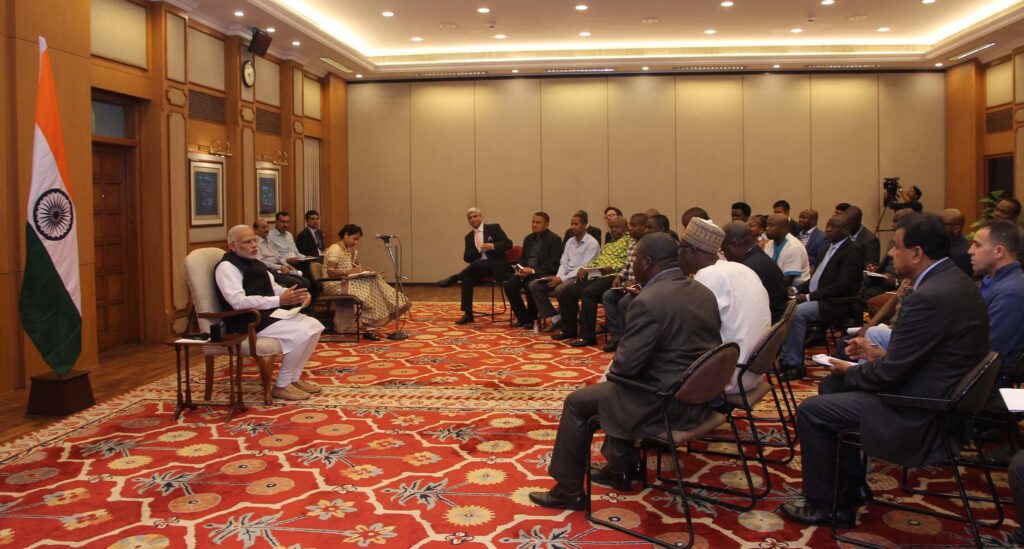
Importantly, the initiative also complements the Government of India’s ongoing public diplomacy efforts. Over the years, India has invited African journalists and media professionals under various outreach and familiarisation programmes to experience India’s democratic institutions, developmental models, technological innovations, and cultural diversity firsthand. While these initiatives have generated goodwill, they have largely remained episodic and state-driven.
A dedicated media network can institutionalise these interactions and convert short-term exchanges into long-term professional collaboration. In doing so, it can leverage India’s decades-old diplomatic investments across Africa — from anti-colonial solidarity and Non-Aligned Movement ties to contemporary development partnerships, capacity-building programmes, digital cooperation, healthcare diplomacy, and educational exchanges.
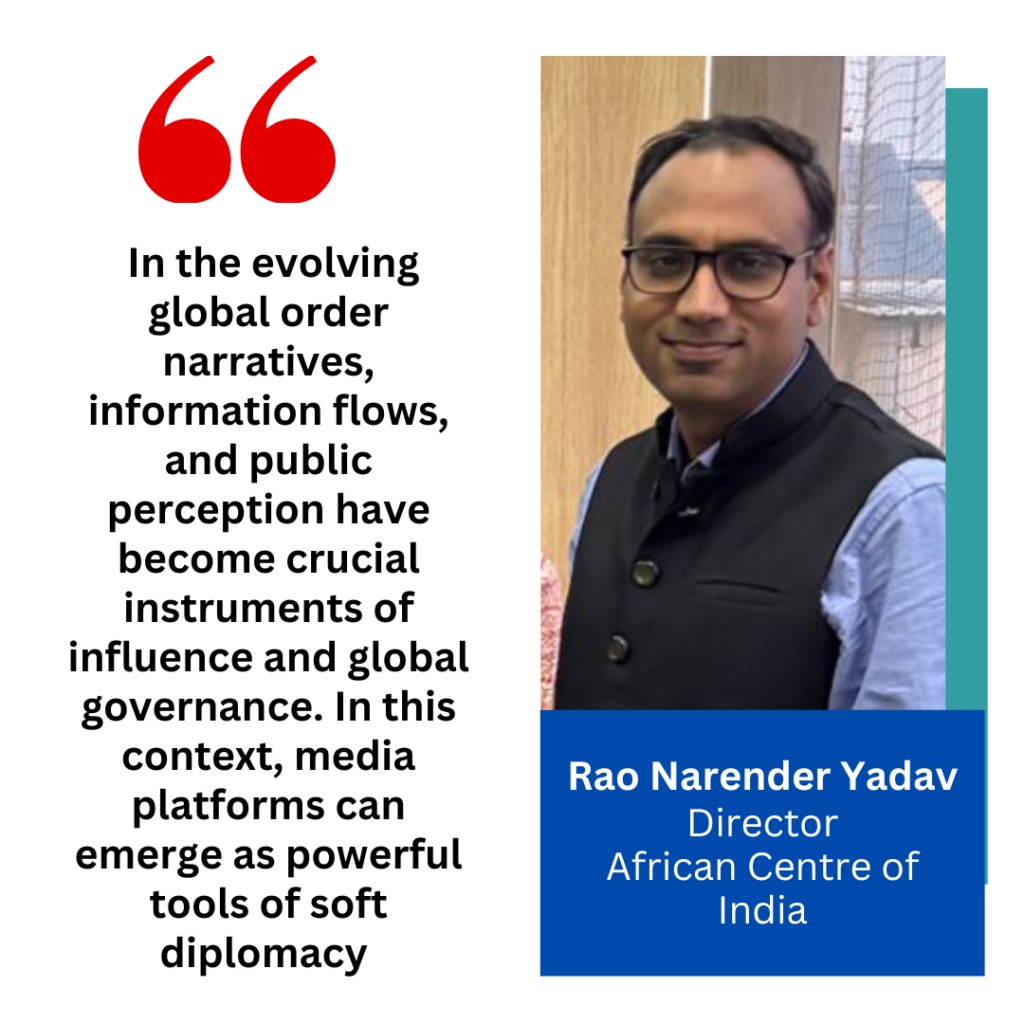
As Rao Narender Yadav, Director of the African Centre of India, notes, “Stronger media collaboration is essential to building deeper societal understanding and long-term people-centric partnerships. At a time when global diplomacy is increasingly shaped by narratives and public perception, media networks can become powerful instruments of soft diplomacy — fostering trust, cultural connectivity, and shared Global South perspectives beyond formal statecraft.”
The timing of this initiative is especially significant because global diplomacy itself is undergoing a major transformation. In today’s multipolar world, geopolitical competition is increasingly accompanied by narrative competition. Media and communication ecosystems have become central to soft power, strategic influence, and international perception-building.
At the same time, Africa has emerged as a key geopolitical arena, attracting intensified engagement from China, the United States, the European Union, Russia, Turkey, and Gulf countries. India too has expanded its footprint across the continent, but its soft-power and media architecture has not kept pace with its growing strategic ambitions. An India–Africa Media Network can therefore help fill an important strategic gap.
The upcoming India–Africa Forum Summit provides the ideal backdrop for such an initiative. After the long gap since the 2015 summit, IAFS-IV is expected to focus not only on trade and geopolitics, but also on building stronger institutional and societal linkages. Media cooperation naturally fits within this broader objective. More importantly, it recognises a key reality of modern diplomacy: soft diplomacy often acts as the silent enabler of enduring strategic partnerships. Governments may sign agreements, but lasting trust and societal connectivity are built through sustained communication and shared narratives.
An India–Africa Media Network could become more than a media initiative. It could emerge as a vital bridge connecting two rapidly transforming regions seeking a stronger voice in an evolving global order.