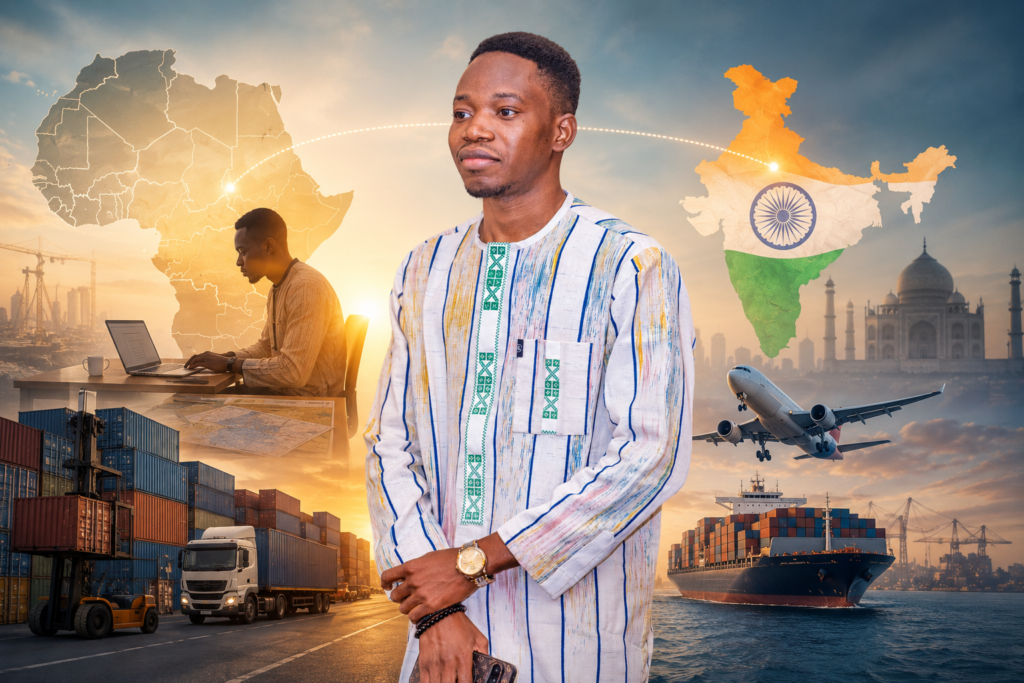
On an ordinary day, Joel Ouoba can be found negotiating with manufacturers in India, coordinating shipments to West Africa, discussing investment opportunities in Dubai, or exploring industrial partnerships in China. Yet, just a few years ago, the young entrepreneur from Burkina Faso was living in a university hostel in Greater Noida, trying to make ends meet while pursuing a degree in architecture.
His entrepreneurial journey did not begin with venture capital, family wealth or a grand business plan. It began with notebooks, pens and hand-drawn portraits.
In this exclusive conversation with Rao Narender Yadav, Editor-in-Chief of India-Africa Today, Joel Ouoba, Founder & CEO, UPDOWN TRADE, DAALI & AABMC reflects on his remarkable journey – from a student to an entrepreneur building bridges between continents. He shares lessons on resilience, leadership, and why he believes Africa’s greatest opportunity lies not in its resources alone, but in its people, partnerships and ambition.
Q. When you arrived in India from Burkina Faso as a student, did you ever imagine that one day you would build an international business connecting Africa and Asia?
Joel Ouoba: Honestly, no.
When I came to India, my goal was to study architecture, complete my degree and return home to build a professional career. But sometimes life redirects you towards your true calling.
Even before coming to India, I had experimented with small businesses in Burkina Faso. However, my grandfather strongly encouraged me to pursue higher education in India because he believed it would prepare me for opportunities far greater than either of us could imagine. Looking back, his advice changed my life.
Like many international students, I arrived with limited financial resources. To support myself with dignity, I, initially searched for manual work, even at construction sites. Unfortunately, those opportunities never materialised. Rather than becoming discouraged, I looked around the campus and observed that students constantly needed stationery, household items and practical assistance. I began keeping notebooks, pens and other essentials in my hostel room. Students from India, Burkina Faso, Nigeria, Mali, Guinea and many other countries knew they could come to me whenever they needed something.
I also loved drawing. Soon I was creating portraits for birthdays, graduation gifts and family occasions. Later, I started helping students buy and sell refrigerators, furniture and other household items whenever they moved.
Looking back now, I realise those activities were my first lessons in entrepreneurship.
Q. Many businesses struggled during COVID-19. For you, however, it became the turning point. What changed?
Joel Ouoba: COVID-19 completely transformed my thinking. During the pandemic, the world stopped. Universities closed. Travel became impossible. Supply chains were disrupted.
Yet something very interesting happened.
Although people couldn’t travel, business didn’t stop. African entrepreneurs still needed products from India. Indian manufacturers still wanted customers across Africa. The demand remained – but the bridge had disappeared. That was the moment I realised there was an opportunity much bigger than anything I had done before. I asked myself one question: “Why not become that bridge?”
That simple idea became UPDOWN TRADE.
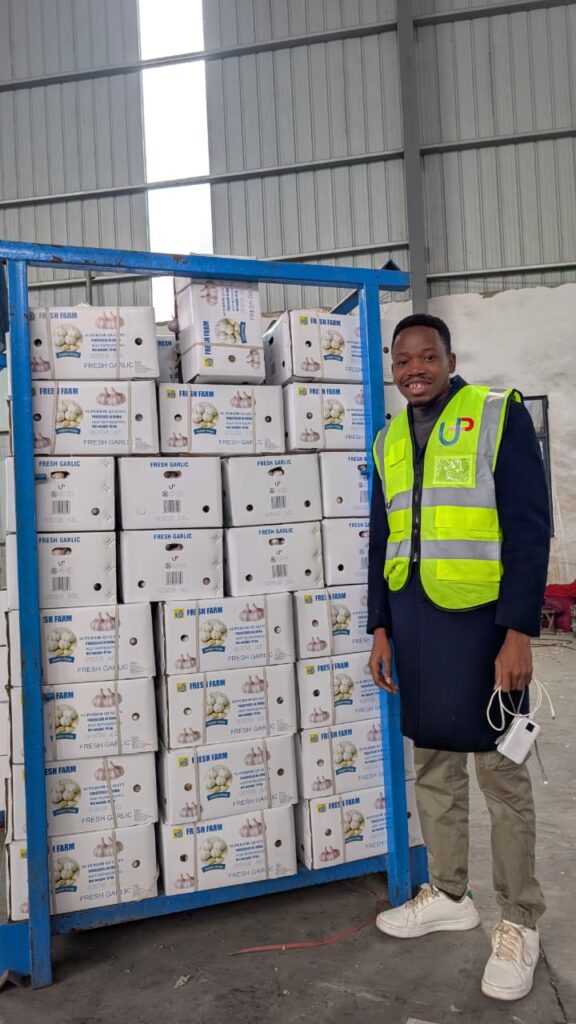
Initially, we connected African buyers with Indian suppliers. As relationships developed, we expanded our role. We began sourcing products ourselves, managing exports, handling logistics and creating structured commercial partnerships.
Later, our activities naturally expanded into China, Dubai and other international markets because businesses were looking for trusted partners who understood different cultures and markets.
Q. Looking back, what were the biggest challenges in transforming UPDOWN TRADE into an international company?
Joel Ouoba: The biggest challenge wasn’t finding customers. It was building credibility.
As an international student, I quickly realised that having a good business idea is very different from operating legally across borders. You need proper company registration. You need the right visa. You need banking systems, contracts and compliance. Without those foundations, it’s extremely difficult to build lasting partnerships. Those years taught me one important lesson: legality creates trust.
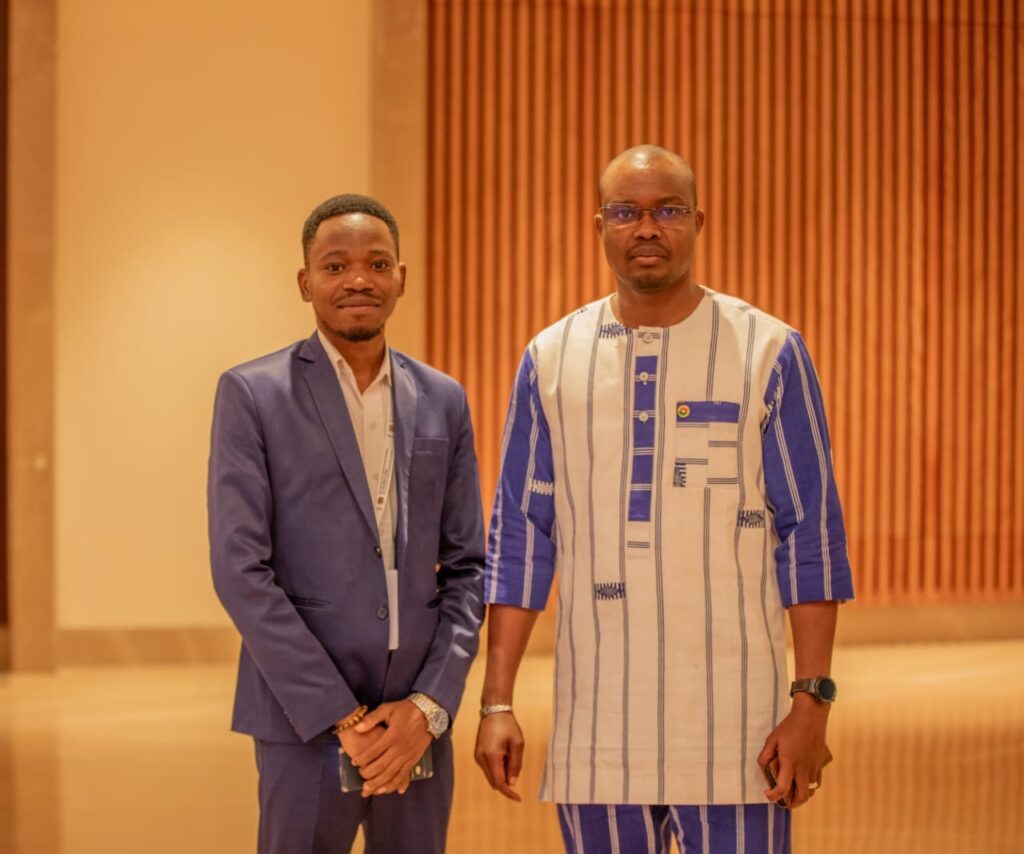
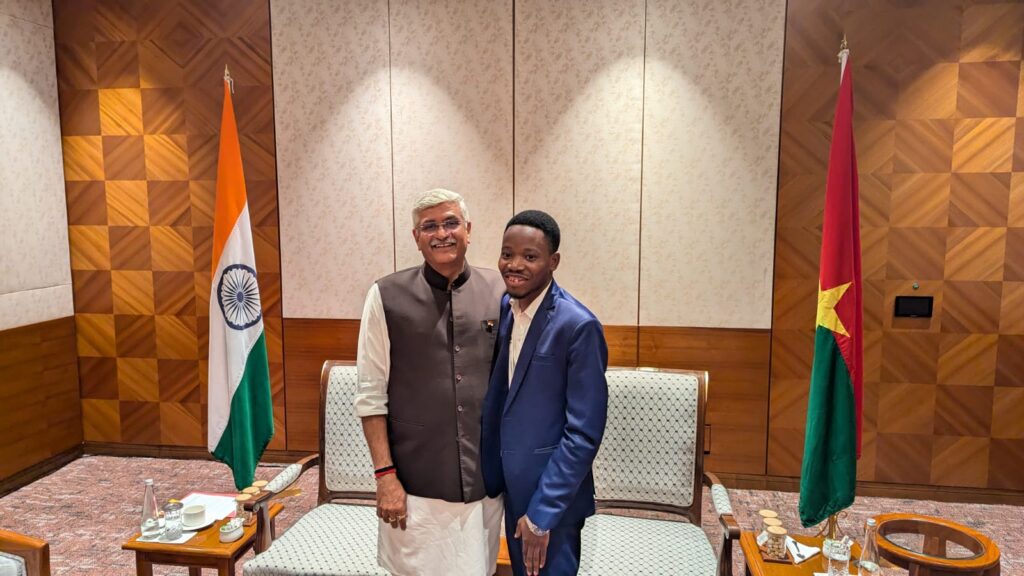
(Left) Joel with the interim Prime Minister of Burkina Faso Jean Emmanuel Ouédraogo, and meeting Union Minister of Culture and Tourism, GOI, Gajendra Singh Shekhawat (Right)
In the beginning, my role was mostly to introduce buyers to suppliers. If everything went well, people appreciated my efforts. But if something went wrong, I had very little control because I wasn’t operating through a fully structured business. I realised that if I wanted to build something sustainable, I couldn’t remain just a facilitator. I had to become an operator.
That meant formalising the company, investing in proper systems and taking responsibility for every stage of the transaction. It wasn’t easy.
Registering the company in Burkina Faso was one milestone. Building the legal structure necessary to operate effectively in India took almost four years. Those years tested my patience, but they also strengthened my discipline.
Q. How has your vision evolved over the years?
Joel Ouoba: Trade opened the door, but it isn’t the destination. For too long, Africa has exported raw materials and imported finished products. That model creates dependency. The future lies in industrialisation.
One achievement that gives me great satisfaction is our work with Indian partners in establishing manufacturing activities in Burkina Faso. Seeing Indian professionals working alongside African teams to transform local resources into finished products is much more than a business success. It represents a different model of cooperation. Instead of simply selling products, we are creating value together. That is the future I believe in.
Africa possesses extraordinary natural resources, a young population and enormous market potential. India brings innovation, entrepreneurship and affordable technology. China contributes manufacturing expertise and industrial capacity. The Middle East offers logistics and investment. If these strengths come together through genuine partnerships, we can create one of the world’s most dynamic economic corridors.
That is much bigger than trade. It is about building industries, creating jobs and transforming economies.
Q. Many people still associate Africa with poverty and conflict. Through your work, what story are you trying to tell the world?
Joel Ouoba: I believe one of my greatest responsibilities is to help change the way Africa is perceived. Too often, conversations about Africa begin with its problems. But every region has challenges. What is frequently overlooked is Africa’s resilience, innovation and extraordinary entrepreneurial spirit.
The Africa I know is full of young people building companies, creating jobs and finding solutions despite difficult circumstances. Across the continent, entrepreneurs are quietly transforming their communities. They may not appear in international headlines, but they represent Africa’s future.
We should also remember that Africa’s story did not begin with colonialism or poverty. It is home to some of the world’s oldest civilizations, trading networks and centres of learning. That history matters because it reminds us that innovation and enterprise are deeply rooted in our societies.
Today, Africa is entering a new chapter.
Our ambition is no longer limited to exporting raw materials. We want to manufacture, innovate and compete globally. We want stronger industries, modern infrastructure and knowledge-based economies. This is why I believe partnerships with countries like India are so important.
India understands what it means to grow through entrepreneurship, affordable innovation and human capital. There are valuable lessons Africa can learn, but there is also much that India can gain from Africa’s expanding markets, youthful workforce and abundant opportunities.
Real partnerships are built on mutual respect.
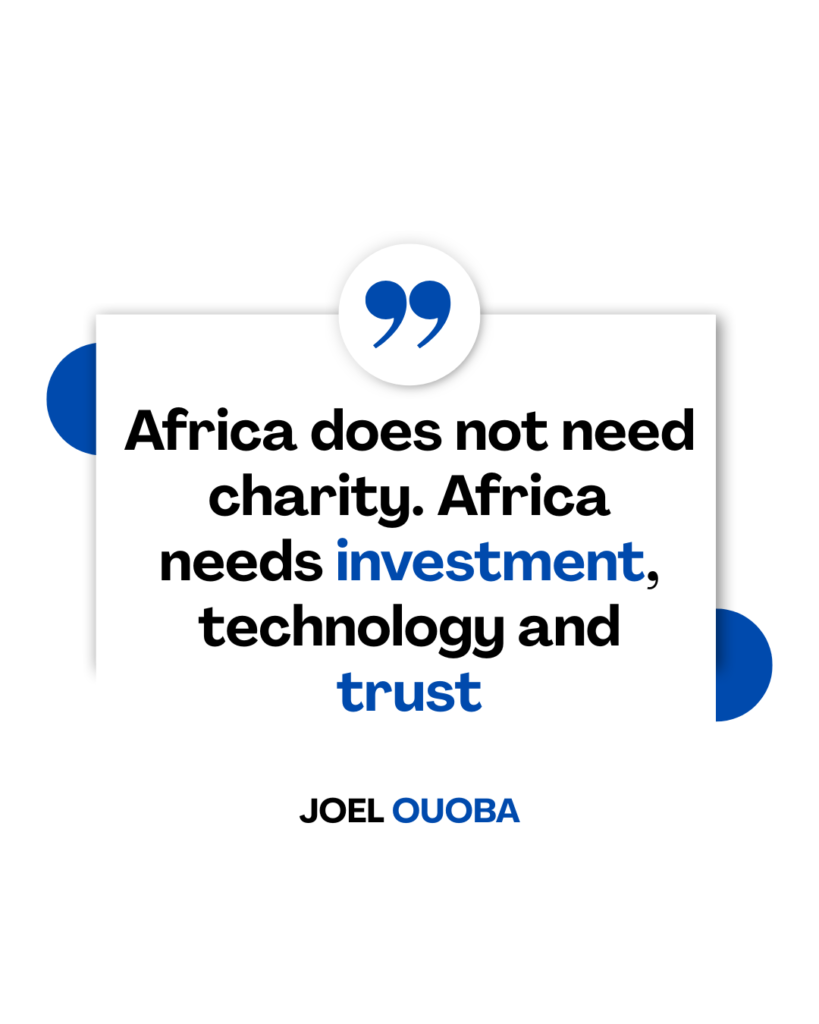
Q. Every entrepreneur experiences moments of doubt. Was there a time when you wondered whether your dream would survive?
Joel Ouoba: Absolutely. The year 2024 was the hardest period of my life as an entrepreneur.
I was trying to balance university studies with the rapid expansion of our business. The pressure became so intense that I had to temporarily pause my education to focus on stabilising the company.
At the same time, we suffered two devastating commercial losses. One international aluminium transaction failed after payments became blocked and deliveries could not be completed. Soon afterwards, another shipment involving five containers of onions was delayed for so long that the cargo perished before reaching its destination. Combined, the losses exceeded one hundred thousand US dollars.
For a young entrepreneur, that kind of setback is emotionally exhausting. There were moments when I questioned every decision I had made. But those experiences also transformed my understanding of leadership.
People often think leadership means making decisions when everything is going well. I believe leadership is revealed when everything appears to be going wrong. There were times when cash flow became extremely difficult, yet I made a conscious decision that my employees would always be paid before I paid myself.
A business is never only about its founder. It is about the people who believe in your vision and whose families depend on that organisation.
Those difficult months taught me lessons that success never could.
Q. You often say that every African entrepreneur abroad becomes an ambassador for the continent. What does that responsibility mean to you?
Joel Ouoba: Every time I meet an investor in India, a manufacturer in China or a business leader in Dubai, I know they are forming impressions that extend beyond me.
For many of them, I may be one of the first African entrepreneurs they have worked with. That creates a responsibility. Professionalism, honesty and reliability are not simply business values. They shape perceptions. If I honour my commitments, people gain confidence not only in my company but also in doing business with Africa. That matters because trust attracts investment.
Over the years, I have also tried to help other African entrepreneurs who encounter challenges while sourcing products from Asia. Sometimes they struggle with suppliers. Sometimes they face logistics or contractual problems. Whenever possible, I try to connect them with reliable partners because I believe success should create opportunities for others.
Business becomes meaningful when it builds ecosystems rather than individual success stories.
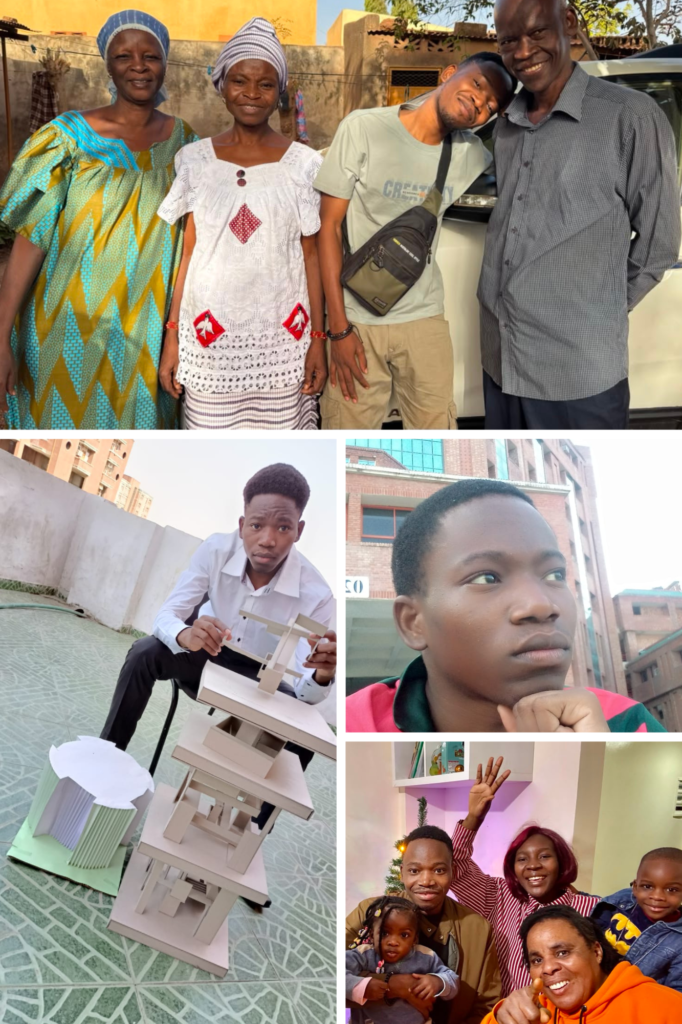
Q. Who have been the greatest influences in your life, and what values continue to guide your leadership?
Joel Ouoba: Without a doubt, the greatest influence in my life has been my father.
My entrepreneurial journey did not begin in a business school or a corporate office – it began in a small village in Burkina Faso. My father owned a modest shop near our local school, and from the age of five, I spent most of my time there. I watched customers come and go, observed how he managed the business, and gradually took on small responsibilities myself. Those early experiences became my first lessons in entrepreneurship.
People in our village affectionately called my father “the Local Chinese” because of his extraordinary work ethic. He worked tirelessly from sunrise until late at night and rarely took a day off. Watching his dedication taught me that work is not merely a means of earning a living – it is a discipline, a responsibility and a way of contributing to society.
Another powerful influence in my life has been books. Even before finishing secondary school, I had read hundreds of books, particularly on African history, culture and civilisation. They deepened my understanding of our heritage and strengthened my pride in being African.
When I came to India, my reading expanded to include leadership, entrepreneurship, business strategy and personal development. Those books reinforced an important lesson: before you can build a successful business, you must first build yourself.
Over the years, five principles have remained the foundation of my leadership : hard work
Responsibility, integrity, resilience; and, finally legacy.
When people remember my journey, I hope they remember not just the businesses I built, but the lives I touched and the opportunities I helped create.
Q. What Does Success Really Mean to you?
Joel Ouoba: My definition of success has changed completely. When I was younger, I thought success meant financial independence. Today, I believe money is only one part of the equation. Profit allows a business to survive. But impact gives that business purpose.
History remembers people because of the difference they made, not because of the size of their bank accounts. That is why I now think much more about legacy.
If my work helps strengthen Africa’s partnerships with Asia and encourages even a few young people to believe in themselves, I will consider that my greatest achievement.